
49,342 MWh electricity was traded in August in the Hungarian Power Exchange. The average daily trade is 1,592 MWh, the standard deviation is 992 MWh. The average price for the month is 80.8 EUR/MWh. The exceptionally high average price was caused by August 16 on which the daily base price was 1,148 EUR/MWh and daily peak price was 2,260 EUR/MWh. That was due to the fact that between 9 am and 6 pm 879 MWh electricity was traded near the maximum price the system would allow (3,000 EUR/MWh).
9/08/2010
HUPX Performance in August


8/13/2010
Slovakia Rejects Participation in Greece Bail Out
Slovak Spectator reports that Iveta Radičová’s new Slovak government proposed the Parliament to reject participation in the eurozone's loan programme to hard pressed Greece. Of the 79 MPs from the ruling coalition parties, only two deputies voted in favour of the bilateral loan that may reach €816 million over the next three years, and one of them says she pressed the wrong button. The largest opposition party, whose previous government approved the deal on the EU summit, did not attend the vote.
After Hungary keeps signalling that it wants to choose a different path recommended by the EU and the IMF outside the eurozone, Slovakia shows that you can dissent within the euroclub, too. Time will tell if the new-found financial sovereignity of the two countries that adds to the traditional EU-scepticism of the Czech politics, will be sustainable.
8/11/2010
Logistics Performance Index
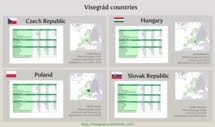
The World Bank Logistics Performance Index benchmarks each countries logistics competitiveness based on a global survey of freight forwarders, logistics providers and professionals. The landlocked Visegrad countries (with the exception of Poland, which has big ports) have a roughly similar profile, ranking well above the world average, but below logistics champions such as the Netherlands, Germany or Denmark.
Currently we are working on a similar survey to understand better the global connections, bottlenecks, strength and weaknesses of the Hungary-based transport, freight forwarding and logistics business.
8/06/2010
Hungarian Power Exchange Went Live
The new Hungarian power exchange, HUPX went live on 20 July. As the transaction clearing have not went under a serious stress test yet, the volumes and liquidity is modest. However, it is likely that HUPX will draw volumes from the Prague-based PXE, whose small Hungary section is competing for the same traffic. 
The Hungarian power market, like many European markets, is still largely an OTC market. Since demand for power dropped sharply in 2008-2009, the prices follow the EEX prices, which becomes more and more a benchmark for all Central European power markets.
7/16/2010
2008 Investment Returns in the EU
 Gross return on capital employed, before taxes, in the non-financial sector. The data are for 2008 when the Big Crisis began. The best investment returns were offered by Lithuania, Latvia and Slovakia. Hungarian returns were rather poor in 2008 as the country were almost in recession since 2006.
6/07/2010
District Heat Map for Hungary
District heating is one of the utilities in Hungary that may undergo the deepest technological and regulatory changes in the next decade. A scattered, locally regulated industry that started to gain new sources of investment and revenue through electricity co-generation to the newly liberalized market and the biogas-biomass renewable bonanza offers a wide variety of business models from heavy loss-making municipal companies to highly profitable private ones.
View Távhőszolgáltatás - disctring heating in a larger map. Colours: Geothermic, Up to 700 units, 700 to 3,000 units, 3,000 to 10,000 units, 10,000 to 250,000 units
We have placed all licensed district heating system operators on Hungary’s map. The different colors refer to the size of the business.
5/26/2010
Mining map of Hungary May 2010
Here is the latest mining map from Hungary, including different types of mining plots and explorations. Although the information is freely available from the mining authority, it may be rather cumbersome to correctly view it with labels, especially in English. 
5/18/2010
Foreign Investments In Europe Before the World Crisis
Although each investor is looking for the best investment, the decisions of the others reveal important characteristics of the investment destinations. The last reliable data internationally is available for 2008, the start of the world economic crisis. In the business cycle before the big criris the Visegrad Countries, especially Hungary and Slovakia has been very attractive investment targets.
The World Bank data are partly misleading, as they comprise equity FDI into the financial sector, which will partly be used elsewhere, where loans or insurance claims are made - this makes the Benelux area and the UK slightly incompatible with the rest of Europe. However, in Central Europe most of the direct investment went into manufacturing and services. The big question is if the Visegrad Countries will remain competitive after the crisis. The answer is most probably yes: Poland has conducted a large-scale privatization program during the world economic crisis and maintained growth even in 2009. The currency devaluation in Poland, the Czech Republic and Hungary will help export greatly in 2010.

Surprise Surge in Hungarian Net Wages
As more and more endebted governments find out that most of their expenses are wages paid to civil servants, public employees and a wage cost base for state owned enterprises, it is rather surprising to see that Hungarian net wages have grown in these sectors dramatically. Net wages are up by 4.2% in the private sector and 8.9% in the public sector after netting for some one-off payments.
Most of the net wage surge is do to a personal income tax reduction by the outgoing government, which was performed despite the dire state of the national budget in order to improve tax paying discipline. The public worker pay is up by 11.9 on a year-on-year basis but only because the government rescheduled some items from 2009.
If the government was right and the surge would be due to an increased tax base (i.e. non-tax paying illegal work shifted towards legalized income) the statistics would be most welcome. However, as such effects are unlikely to happen within the public institutions (well, who knows?) it is more likely that the wage increase will bite into the competitiveness of the national economy.
Feliratkozás:
Bejegyzések (Atom)

 Bejegyzések


