
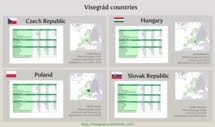
The World Bank Logistics Performance Index benchmarks each countries logistics competitiveness based on a global survey of freight forwarders, logistics providers and professionals. The landlocked Visegrad countries (with the exception of Poland, which has big ports) have a roughly similar profile, ranking well above the world average, but below logistics champions such as the Netherlands, Germany or Denmark.
Currently we are working on a similar survey to understand better the global connections, bottlenecks, strength and weaknesses of the Hungary-based transport, freight forwarding and logistics business.
A következő címkéjű bejegyzések mutatása: infrastructure. Összes bejegyzés megjelenítése
A következő címkéjű bejegyzések mutatása: infrastructure. Összes bejegyzés megjelenítése
8/11/2010
Logistics Performance Index


2/05/2010

2/03/2010
V4 Transport Markets and Infrastructure Constraints
The passenger and freight transport markets of the V4 countries are notably different from Western European or U.S. markets. On the freight market, railways have a higher market share than in Western Europe and lower than in the U.S, Ukraine or Russia. On the passenger market, railways have higher market share than in the U.S. or in Western Europe and lower than Eastern Europe.
Many people think that motorization will follow the same route as in Western Europe and road transport will take over rail transport in both freight and passenger markets. However, taking a look at the map above shows that you need a different strategy in these countries as there are fundamental differences that will prevail for decades, or maybe forever.
You can have a look at our visualization created by Many Eyes and look behind the maps to see the data (Java Applet may take some time to start on your computer)
The bottom line is that Central Europe has much higher railway density than Western Europe (and much lower than Eastern Europe). This corresponds with greater physical distance among cities and lower population density. As the railways have a comparative, and sometimes absolute advantage over road transport, the bet is that you will get a mixture of the West- and East-European logistics plus a bit of the U.S. system. If your good or passenger flow has to be managed between East and West, you need to rely on railways, as the railway density goes up if you go the East and the road density goes down. If your streams are North-South you may use the Danube or probably you can rely on roads and railways, too.
More on transport.
1/29/2010
Southstream Kick-off in Budapest
The state-owned Hungarian Development Bank and the Russian state-owned Gazprom energy company has established a project company today to start development works related to the building of the Russian-initiated South Stream natural gas pipeline in Hungary. The pipeline is competing with the EU-initiated Nabucco pipeline that would follow a similar route, however, it would allow to pump gas from a more diversified source. Like the North Stream pipeline, South Stream will bypass the current main route through Ukraine and will lessen Russia's dependence on transit country's to sell gas to the EU.

Image: Wikimedia
However, it is still unclear who will sell and who will buy gas through the South Stream system, so the building of the project is not entirely certain.
The day before the signature it was reported that Jacques Chirac refused Russian prime minister Putin's invitation to chair the South Stream consortium. If he did not decline, he would have been in the position with former German Chancellor Gerhard Schroeder to directly discuss trade disputes between European consumers and Mr Putin. Mr Chirac is the second politician to refuse such an offer: former EU Commission President and Italian prime minister Romano Prodi had also declined the offer.
There are two countries in Central Europe which have the biggest stake in the Nabucco-South Stream race. Nabucco would only secure Romania's access to natural gas, while South Stream would only go through Serbia, a country that suffered a lot during last year's energy crisis.
1/24/2010
Archive: London - Istambul Road
Text: New Hungarian automobile route. The governor inaugurated the newly finished Budapest - Kecskemét part of the London - Istanbul transcontinental automobile road.
The route, although rebuilt as a motorway is part of the IVth Pan-European transport corridor, which is an extension of the EU's Trans European Networks to Eastern Europe. The IVth corridor connects Germany, the Czech Republic, Slovakia, Hungary, Serbia, Bulgaria and Turkey. Transport routes do not change much over the centuries.
Feliratkozás:
Bejegyzések (Atom)

 Bejegyzések


