
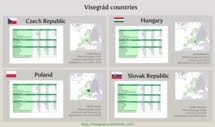
 Gross return on capital employed, before taxes, in the non-financial sector. The data are for 2008 when the Big Crisis began. The best investment returns were offered by Lithuania, Latvia and Slovakia. Hungarian returns were rather poor in 2008 as the country were almost in recession since 2006.
A következő címkéjű bejegyzések mutatása: investment. Összes bejegyzés megjelenítése
A következő címkéjű bejegyzések mutatása: investment. Összes bejegyzés megjelenítése
7/16/2010
2008 Investment Returns in the EU


4/22/2010
Hungary is the biggest capital investor in Montenegro
The Hungarian Foreign Minister Mr. Péter Balázs paid an official visit to Montenegro and met his counterpart Mr. Milan Rocen. They welcomed the flourishing of economic ties between the two countries: Hungary, to date, has been the biggest foreign direct investor in Montenegro. Large Hungarian companies are present in the banking sector, telecommunications and the hotel industry. Mr Balázs emphasized that Hungary is seeking new areas of mutually advantageous cooperation, and urges Montenegro to have its legislation even more investment friendly so that it could not only attract new investors but make life easier for the ones already settled. (Source: Ministry of Foreign Affairs of the Republic of Hungary) Examining the report of the World Bank Group about Doing Business in the different countries we can see that Hungary occupies the 47th place while Montenegro is the 71st in the ranking. In the case of some factors i.e. enforcing contracts Montenegro could really improve its capability. To enforce a contract in Montenegro costs 25.7% of the claim (it is 13% in Hungary), 49 procedures have to be completed (in the case of Hungary is 33) and it takes 545 days (395 days in Hungary). On the other hand the strength of the investor protection index is 6.3 in Montenegro and 4.3 in Hungary so Hungary could also improve its performance in creating an investor friendly environment.
2/18/2010
Prague, Warsaw, Wien to Create CEE Electricity Exchange
TGE, EXAA and PXE signed today The Memorandum of Understanding concerning strategic cooperation and creating a regional electricity market in Central and Eastern Europe based on Market Coupling.
EXAA Abwicklungsstelle für Energieprodukte AG is power spot market operator in Austria and Germany, and also has a carbon emissions market. EXAA was founded in 2001 and it currently has 82 market participants. EXAA is 34.56%-owned by APCS Power Clearing and Settlement AG, 25.12% belongs to Vienna Stock Exchange, 8.06% is owned by “smart technologies“ Management-Beratungs- u. Beteiligungsgesellschaft m.b.H., 8.06% possesses Oesterreichische Kontrollbank Aktiengesellschaft and the remaining 24.2% stake is shared by eight Austrian Power Trading companies.
POWER EXCHANGE CENTRAL EUROPE, (PXE) an established trading platform for electricity trading in the Czech Republic with relative large trading volumes in Slovakia and a new, albeit yet tiny Hungarian market. PXE was established in 2007 and it currently has 34 market participants. The company is 100% controlled by Prague Stock Exchange (PSE), which is in turn PSE is 93% owned by Vienna Stock Exchange.
Towarowa Gielda Energii SA (TGE) is an established spot electricity, emission allowances, energy certificates and energy derivatives exchange in Poland. The exchange was established in 1999 and since then it has gained 47 market participants. TGE has 17 shareholders the most important one being State Treasury with 22.3% stake. TGE is the sole owner of commodity exchange license in Poland.
Now the interesting question is what will happen with the Slovak and Hungarian market. The PXE has a relatively strong position in Slovakia, however, the Slovak market is not easy to penetrate either as a speculator or as a hedging tool. Slovakia forecloses its border-crossing capacities that makes physical delivery very complicated. The PXE presence in Hungary is rather symbolic with 80 MWs traded in the previous months. Hungary's TSO, Mavir, has its own plans.
The news is very welcome for either companies who want to hedge their electricity price risks or for investors who want to speculate and are looking for an alternative asset class. Although speculating, trading and hedging energy prices is becoming more and more available even for private investors and SMEs, the assessment of possible trading strategies, transaction cost, counterparty, delivery and credit risks is still a formidable task in the V4. Do not hesitate to comment or ask questions on this topic.
Feliratkozás:
Bejegyzések (Atom)

 Bejegyzések


